





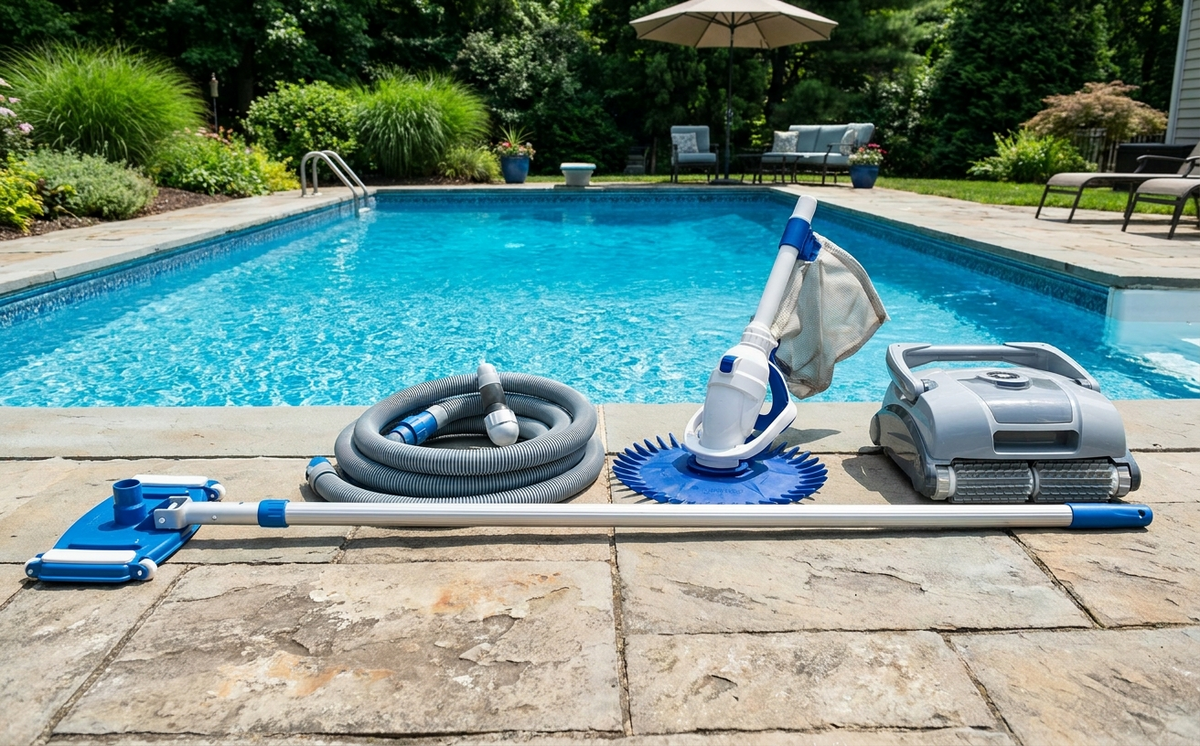
There are four main types of pool vacuums: manual, suction-side, pressure-side, and robotic. Each one removes debris differently, costs a different amount to run, and asks for a different level of hands-on work. The right pick among these pool vacuum types depends on how big your pool is, how much debris falls into it, and how much of the cleaning work you actually want to do yourself
What Are the Main Types of Pool Vacuums
Pool vacuums fall into two broad camps: manual and automatic. Manual vacuums need a person pushing a pole. Automatic vacuums run without you, and within automatic there are three common designs that differ in how they get their power and where the debris ends up. A fifth option, the in-floor cleaning system, is built into the pool itself during construction and mostly shows up on higher-end new builds rather than as a portable vacuum.

Manual Pool Vacuum
A manual pool vacuum is a vacuum head attached to a telescopic pole, fed by a hose that connects to the pool skimmer. With the pump running, suction pulls debris through the head, down the hose, and into the pool filter. You walk the pool edge and push the head across the floor by hand.
Pros
-
Lowest upfront cost ($30 to $100 for head, pole, and hose)
-
Full control over spot cleaning, especially after storms or algae treatment
-
Useful as a backup even when you own an automatic cleaner
Cons
-
Labor intensive, 30 to 60 minutes per session
-
Debris goes straight into the main pool filter, so filter cleaning frequency increases
-
Coverage limited to wherever you guide the head
Suction-Side Pool Vacuum

A suction-side vacuum connects to the pool's skimmer or a dedicated suction port. It uses suction from the filter pump to move itself randomly around the pool floor, and the debris it picks up travels straight into the pool filter.
Pros
-
Most budget-friendly automatic option ($100 to $400)
-
Few electronic parts, so repairs are usually simple and cheap
-
Installs in minutes with no plumbing changes if a suction port is available
Cons
-
Struggles with large leaves and twigs; better suited to sand and fine dirt
-
Cleans the floor but usually not walls
-
Random movement means uneven coverage
-
Debris flows into the main filter, so the filter clogs faster
Pressure-Side Pool Vacuum

A pressure-side vacuum connects to a return jet instead of the suction line. Water pressure from the pump propels it around the pool, and debris collects in a mesh bag attached to the vacuum rather than going to the main filter.
Pros
-
Handles large debris (leaves, acorns, twigs) far better than suction-side units
-
Onboard mesh bag keeps debris out of the main pool filter
-
Some coverage on lower walls in addition to the floor
Cons
-
Higher upfront cost ($400 to $900, plus booster pump if required)
-
Most higher-end models need a separate booster pump (typically 3/4 HP, adds about 700W of energy use while running)
-
Pool must be plumbed for a dedicated return line; retrofit adds plumbing cost
Robotic Pool Vacuum
 A robotic pool vacuum is a self-contained unit with its own motor, onboard filter basket, and often brushes. It runs on low-voltage power or a rechargeable battery, and it operates completely independently of the pool's pump and filter. You drop it in, press go, and it works its way across the floor, up the walls, and along the waterline.
Pros
-
Energy-efficient (about the same as a household light bulb, 100 to 200W)
-
Covers floor, walls, and waterline in one cycle
-
Keeps debris out of the main pool filter
-
Smart navigation on better models means systematic, not random, coverage
Cons
-
Highest upfront cost ($500 to $2,000)
-
Cordless units need recharging (typical runtime is 1.5 to 15 hours depending on battery size); corded units need cable handling
-
Internal basket needs rinsing after each cycle
A cordless robotic vacuum like the iGarden Pool Cleaner K Pro covers floor, walls, and waterline in one cycle, with a 4L debris basket, 180 μm filtration, and 10 to 15 hours of floor-mode runtime per charge.

iGarden Pool Cleaner K Pro Series
Brilliant Sheen & Smart Touch Control and App Control. A Turbine-Grade Impeller & An Optimized Flow System. Intelligent Path Optimization & Adaptive Mobility
How do pool vacuum types compare?
The numbers below are typical residential ranges, not every possible model.
|
Factor |
Manual |
Suction-side |
Pressure-side |
Robotic |
|---|---|---|---|---|
|
Typical price |
$30 to $100 |
$100 to $400 |
$400 to $900 (plus booster if needed) |
$500 to $2,000 |
|
Coverage |
Wherever you guide it |
Floor, random pattern |
Floor and some walls |
Floor, walls, waterline |
|
Where debris goes |
Pool filter |
Pool filter |
Onboard mesh bag |
Onboard basket |
|
Plumbing required |
Skimmer or vac port |
Skimmer or dedicated suction line |
Dedicated return line, sometimes booster line |
None |
|
Effort per cleaning |
30 to 60 minutes active work |
Set up and let it run |
Set up and let it run |
Drop in, empty basket after |
Energy use and lifespan add a second layer. Manual and suction-side units run on the pool pump alone, so they add no extra electricity beyond what the pump already costs. Pressure-side adds about 700W when a booster pump is needed. Robotic units use 100 to 200W. Suction and pressure-side units typically last 5 to 8 years, and premium robotic units last 10 years or more.
Robotic vacuums cost more upfront but use a fraction of the energy of pressure-side systems, so the total cost gap narrows over a 5 to 8 year lifespan. Suction and pressure-side options depend on your existing plumbing, so check what your pool is already plumbed for before buying.
Which Type of Pool Vacuum Is Best for Your Pool
 The right vacuum depends on pool type, the kind of debris you deal with, and how much time you want to spend cleaning. Start with pool size and debris, then factor in budget.
For Above-Ground Pools
A cordless robotic vacuum or a basic suction-side unit is usually the best fit. Above-ground pools run smaller pumps, which suit cordless robotics well and avoid the extra install complexity of pressure-side systems. For very small above-ground pools, a manual vacuum is often enough.
For Inground Pools
The choice scales with pool size. For small inground pools, a basic suction-side unit or entry-level cordless robotic is usually enough. For medium inground pools, a cordless robotic with smart navigation handles floor, walls, and waterline without much input. For large inground pools, a robotic vacuum or pressure-side unit with full coverage is the practical choice; manual vacuuming alone takes too long to stay on top of debris.
For Leafy Pools or Pools Near Trees
A pressure-side or robotic vacuum handles this best. Both keep large debris out of the main pool filter, which matters when leaves and twigs would otherwise clog the skimmer basket or filter weekly. Suction-side models tend to choke on this kind of debris.
For Owners Who Want the Least Work
A robotic pool vacuum is the answer. It runs on its own schedule, covers floor, walls, and waterline in one cycle, and keeps debris out of your main filter. You empty a basket and rinse it off, and that is the full maintenance loop.
For Tight Budgets
A manual vacuum plus a good pool brush is the lowest-cost path. If you want automatic but cannot stretch to a robotic, a suction-side unit gives you the most automation for the money, as long as you are willing to clean the main filter more often.
Pool Vacuum Compatibility With Pool Surfaces
The pool's surface material affects which vacuum types and brush styles are safe to use. The wrong choice can scratch vinyl liners or wear brushes out quickly on rough concrete.
|
Pool surface |
Compatible vacuum types |
What to avoid |
|---|---|---|
|
Vinyl liner |
Manual (soft head), suction-side, cordless robotic with soft brushes |
Stainless steel or stiff wire brushes (scratch the liner) |
|
Concrete or plaster |
All four types |
Soft nylon brushes (wear out fast on rough surfaces) |
|
Fiberglass |
All four types; PVA or soft nylon brushes work best |
Hard wire brushes (can dull the gel coat) |
|
Tile |
All four types; soft brushes preferred |
Aggressive abrasive brushes (damage grout lines) |
For vinyl and fiberglass especially, check that any robotic vacuum's brushes are nylon or PVA, not steel. Most modern robotic cleaners ship with surface-safe brushes by default, but cheap units sometimes do not.
Related Pool Vacuum Guides
These guides cover the most common pairwise comparisons in more depth:
-
Manual vs automatic pool cleaners for the labor-versus-cost split
-
Robotic vs suction vs pressure pool cleaners for choosing between the three automatic types
-
Corded vs cordless pool vacuums for power-source trade-offs within robotic units
-
How does a pool vacuum work for the mechanics behind each type
-
Pool equipment guide for how vacuums fit with the pump, filter, and skimmer
Pool Vacuum FAQs
How often should I vacuum my pool?
A residential pool in regular use benefits from a full vacuum once a week. Pools under heavy tree cover, with high bather loads, or after a storm need it more often. Automatic vacuums can run more frequently because the labor cost is near zero, which keeps the pool consistently cleaner than weekly-only cleaning.
Can I leave a robotic pool vacuum in the pool all the time?
You can, but most owners do not. Extended sun and chemical exposure wear on cables, seals, and coatings faster than dry storage does. Always remove the unit before shocking the pool or before swimmers get in. Concentrated chemicals can damage internal components, and long cords are a hazard around people in the water. Rinse the basket and store in shade for the longest usable life.
Do I need to turn off my pool pump when vacuuming?
It depends on the vacuum type. Manual and suction-side vacuums need the pump on because they rely on it for suction. Pressure-side vacuums also need the pump, sometimes plus a booster. Robotic vacuums run on their own motor, so the pump can stay off or on.
Why is my pool vacuum not picking up dirt?
For manual and suction-side units, the most common causes are a clogged skimmer basket, a loose hose fitting letting air in, or the pump not being primed. For robotic vacuums, check the internal basket for fullness, the brushes for debris tangled around them, and the impeller for obstructions.
Is it safe to vacuum a vinyl liner pool with any type of vacuum?
Most pool vacuums work on vinyl, but the brush head matters more than the vacuum type. Soft nylon, PVA, or rubber heads are safe; stiff wire or stainless steel brushes can scratch the liner. For robotic vacuums on vinyl pools, check the spec sheet for brush material before buying. Manual vacuums for vinyl pools should use a smooth wheel or skid plate at the head, not stiff bristles.
